If everything is a neighbourhood, is anything a neighbourhood?
If everything is described as a neighbourhood, is anything actually a neighbourhood? Explore the word and the data and why it's so confusing

I put a poll on linkedin yesterday morning. I know, what have I become.
It asked a simple question.
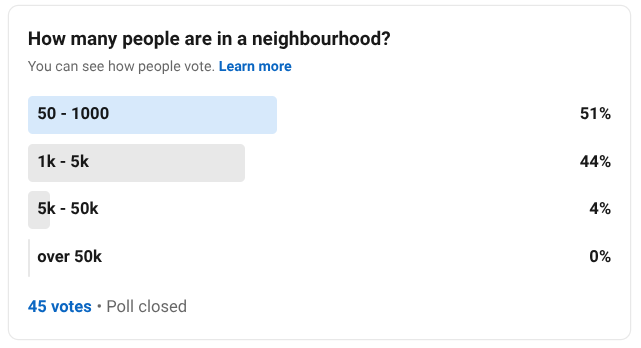
How many people are in a Neighbourhood?
Ok, before we go any further, yes there a few things to note here.
- Linkedin only allow 4 options on a poll. I did not know this. I do now. This is not helpful for such a serious piece of statistical analysis.
- This is not a serious piece of statistical analysis. Look at the options I gave, they are not good.
- This is somewhat an example of something I talk about a lot 'Anchoring' . You should be aware of this when making or responding to surveys.
Now as you can see from the poll most people are in the <1000 camp or between 1k and 5k. Someone did respond saying that they refuse to put themselves in the 5k to 50k even though they would classify a meaningful neighbourhood as around 6k - 8k (the poll options skewed the result). Only 4% of people went with the 5k - 50k.
I suspect that if I ran this properly and properly segmented we would probably group around three main peaks roughly 750, somewhere around 3000 and somewhere around 10000. And if we accounted for rural, town, city and took into account population density, we would probably get something that maybe roughly equates to a square km for most areas that aren't sparse rural land. And interestingly that size roughly equates to around 12 - 15 mins of walking (15 minute cities anyone?) But I didn't do that...
Ok, so what is the bee in your bonnet Tom?
Yes, well. Clearly that poll was half bait, half me wanting to check something that seems so absurd and also allow me to explore that word... meaningful.
I saw the release of London Neighbourhood Explorer which on the announcement said "London was the first Region in England to formally define its Neighbourhood boundaries.." - oh was it? That's interesting I thought to myself. And then I went down a bit of a rabbit hole.
According to NHS England the London Neighbourhood Boundaries were defined in May 2025. And have an average population of... wait for it... 61,000 people and are meant to "reflect natural geographies and recognisable communities".
What is a neighbourhood, depending who you ask
The rabbit hole got deeper. It turns out the answer to my poll question is well documented, but the answer? Well on that it seems there is some disagreement.
- ~1,500 people if you're the government measuring deprivation. The IMD's "neighbourhoods" are really just Lower-layer Super Output Areas - statistical units built with a mean of 1,500 people, originally created for the Index of Deprivation in 2004.
- ~1,500 people if you're the Independent Commission on Neighbourhoods - their 613 "mission critical neighbourhoods" contain 920,000 people. Same LSOAs underneath.
- 1,000 - 3,000 people if you're Lloyds Bank Foundation, whose Good Place Index works at this scale (more on this in a minute).
- 5,000 - 9,000 people if you're Clarence Perry in 1929, whose original neighbourhood unit was sized around one primary school and a quarter-mile walk for a child. Nearly a century old, and still the most honest definition on this list, because it's sized around a human activity rather than a data release.
- ~10,000 people if you're the New Deal for Communities, which defined its 39 neighbourhoods as places of around 10,000 people.
- 5,000 - 15,000 people if you're the government's Pride in Place programme, built on MSOAs.
- 50,000+ people if you're an NHS Integrated Neighbourhood Team. Locality Matters recently made this point well: ask people about their neighbourhood and they name their estate, the school, the GP, the pub - places that typically serve fewer than 10,000 people. At 50,000, local organisations simply disengage. It's not relevant to them.
- 61,000 people if you're NHS London, claiming to reflect "recognisable communities".
Interestingly Dunbar's number puts the limit of stable human relationships at about 150 which definitely feels more in line with the poll results than with the NHS approach.
In fact I'd say that each figure under 10,000 (adjusted for population density) is sized around something human - a school, a high street, a programme people could actually take part in. Every figure above it is sized around something institutional - a delivery footprint, a team structure, a budget line. Or as someone put it on my post "If we're defining neighbourhood as a scale of action, much smaller than you'd think. A scale of administration, much larger" which I thought was quite nice. Every definition of a neighbourhood is really a definition of what the definer needs it for.
Who gets to decide?
The idea of self defined or recognisable boundaries is one I have thought about for years. I always remembered the town I grew up in. There were 3 estates, defined by their brick - yellow, red and black. People from those estates were defined and defined themselves by those boundaries. Were they neighbourhoods? Should they be? Who gets to decide these things.
Back in 2024 Data For Action and Citizen Network were Mapping the Neighbourhoods of Sheffield. Asking people about their boundaries, but also asking much more. What mattered to them in those boundaries? Why?
And the answers were never about population counts (although the numbers were in the 4k range). People drew lines around a few streets. A park. The shop. The school run. The boundaries were small, personal, and there was nuance and disagreement, but I'd say they meant something because people had drawn them. I wrote about this in Maps as conversations - when people recognise themselves in a map, they talk, they engage, they act.
ICON's own opinion research talks about the "hyper local" level, particular estates, groups of houses, streets, where people expressed pride, belonging and personal investment that was distinctly lacking at every geography above it. ICON were in many ways piggy backing on work that had been discussed for years before, but even with all the connections they had, it still feels that the real message was lost.
So back to that word. Meaningful.
What does Neighbourhood actually mean? Well there are several definitions. In topology, a neighbourhood of a point is the set of everything close enough to it - and it's defined from the point outward. So imagine a person as the point. Their neighbourhood is often everything in relation to them. That's why in the neighbourhood mapping project we often talked about 'fuzzy boundaries'. It's also about what you can reach. The mathematical definition calls it an open set - with room to move "some amount in any direction" without falling out, this maps to the 10 -15 minute walk.
When the word neighbourhood can mean a few hundred people on an estate or 61,000 in a delivery footprint, it stops meaning anything at all. It becomes a unit of administration dressed up as a unit of belonging. A word borrowed to make bureaucracy feel human. The same is happening to place and community - words that should describe relationships getting quietly redefined as geographies that suit the org chart.
The Good Place Index is perhaps one on that list reaching in the right direction, maybe. It certainly works at the human end of the scale, and more importantly it starts from how people are doing and feeling - wellbeing, agency, trusted connections - not just what an area looks like on paper.
But... it's still an index. And I've got form with indices ( what the IMD has ever done for us). Decades of authoritative deprivation data, billions in targeted investment, and the most deprived places are still the most deprived places. Better-defined boundaries and better-constructed indexes don't automatically change anything. I read a piece this week that made a version of this point: your insight is fine, you just don't have a process. Organisations are drowning in insight and starved of the mechanisms to act on it. Data and action are not the same thing, and they are very rarely aligned.
So what makes a neighbourhood meaningful? I don't think it's the population size really. In fact I don't think it's the boundary at all. I think it's whether the people inside it would recognise it, and whether they have any agency within it. A neighbourhood is meaningful when it's something people do, not something done to them. That's why I keep banging on about data as conversations - meaning isn't in the dataset or the boundary file, it's in the ongoing dialogue about what they mean and what happens next. And it's why I'm so pleased to see Opus pick up the Neighbourhood Mapping work in Sheffield and help explore ways to take action.
So here's a simple test for anyone defining neighbourhoods, places or communities: would the people inside the line say it's theirs? If yes, you've defined a neighbourhood. If no, you've defined a delivery area. Both are fine. Just don't call the second one the first.
And maybe all this is a moot point. Maybe all the decisions have already been taken. But I for one think we need to keep this on the agenda. Keep talking about it, because although everything is called 'something something neighbourhood something' now, we can at least give people ways to discuss, ask questions, push back.