Is the best way to actually make AI work in an organisation to focus on constraints?
Pondering on how we actually need to focus on constraints when everything and anything is possible
Is the best way to actually make AI work in an organisation to focus on constraints?
AI offers so many opportunities that we end up doing a bit of everything… and realising the gains from none of it. The menu is endless, so you stare overwhelmed and walk away and get chips.
Users when landed with a new tool that can do so many things often go in wide ranges - questions or tasks that are too broad, too narrow, too difficult, too easy and then don't see the value.
Go back a couple of years and prompt engineering was all the rage as it in some ways provided constraints. But then reasoning models came along and we moved away from that. Which is fine for individuals. But not when it comes to AI in organisations and in services
Constraints are what turn possibility into progress:
- Pick a service (not a shiny tool).
- Name the job to be done and the users who benefit.
- Define what “good” looks like (time saved, errors reduced, quality improved).
- Set boundaries: what it is for, what it isn’t for, and when a human must step in.
- Build the simplest workflow that makes it repeatable, measurable, and safe.
All the talk at the minute is to experiment, don't be left behind. Yes, experiment to find the edges, but then commit to a few well-scoped uses and ship them inside real services.
It’s the same with data: having all the data often tells you nothing. Value comes from purpose, definition, and decision-making constraints.
Constraints can take many forms
- Purpose constraint: This assistant drafts first versions of X for Y audience. It doesn’t approve, decide, or sign off.
- Context constraint: Only use these sources/records. If they’re missing, ask for them (or say you can’t).
- Output constraint: Use this template, include these fields, keep it to 200 words, match this tone.
- Risk constraint: If the topic touches safeguarding/legal/finance, route to a human or require a second check.
- Quality constraint: State assumptions, flag uncertainty, and link back to the source of truth.
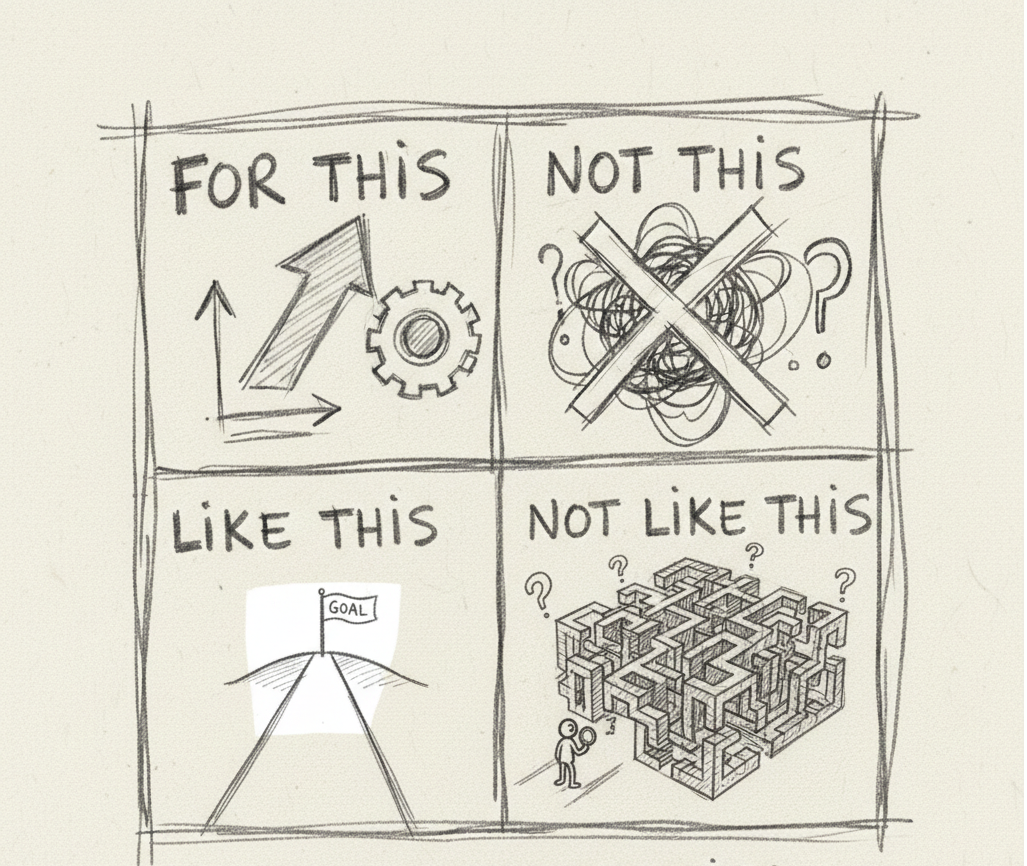
But mainly they come down to For this, not this. Like this, not like this.
Hmm. Maybe I’ve just described service design.