The Garden of Ideas
The Garden Ideas, a simple facilitation tool for individuals and groups. Seeds, soil, seasons, pruning and composting as a way of making intentional choices
Ideas are easy...[insert one of the many quotes about execution/implementation/teams and stuff here]
I dunno. Are ideas easy? Maybe. Good ideas probably less so. But there is some truth that some of what stops ideas becoming more than that is choices and decisions. Often it's the choice to not do something, so that another idea can grow. And to grow an idea we often need to make decisions about when and how.
There are many tools and frameworks that can help you with these things, stop/start/continue, now/next/future, matrix of all types. So why another one Tom? I dunno, I guess I just kind of like gardens and metaphors.
So I put together The Garden Ideas, a simple facilitation tool for individuals and groups.
First, the metaphor.
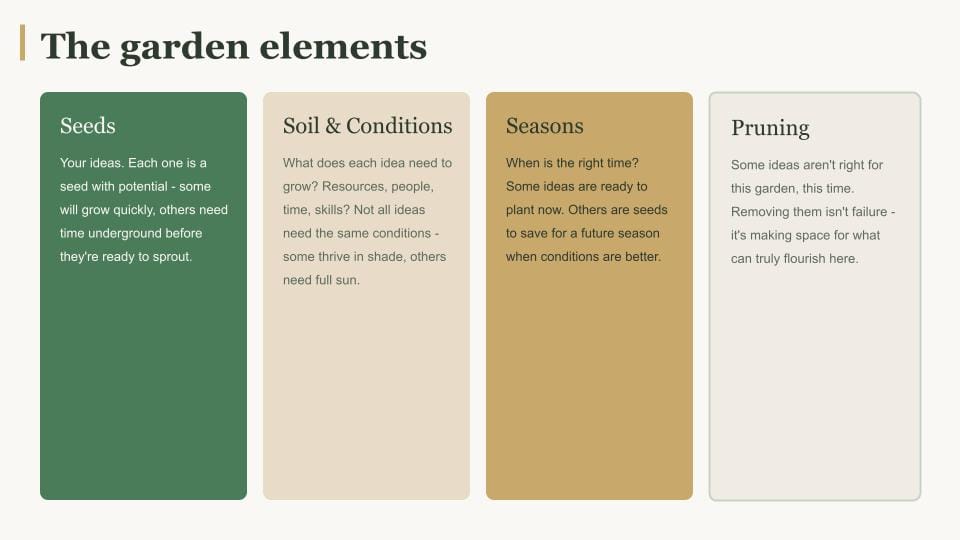
A garden isn't a holding space where things wait indefinitely. It's a living system that forces honest choices. Seeds are planted with intention (mostly though there always surprises or is that just me?). Some sprout quickly (hopefully). Others need time underground before they're ready. And crucially, not everything gets planted, a gardener makes choices about what the space can actually sustain and hopefully how the plants interact. Pollinators and fruit, complementary plants that sustain the soil etc.
Framing our ideas as seeds, our soil as conditions, our pruning or composting as choices seems to land with people. And in a world where our to-do list never shrinks, this approach can feel both kinder and more decisive.
Composting feels kinder than deleting. When we decide an idea isn't right for this garden, this time, we're not throwing it away. We're returning it to the soil. It might nourish something else later. This matters when you're staring at a to-do list that's become a guilt list.
Banking seeds is strategic, not procrastination. A seed bank isn't where things get forgotten, it's where they're preserved for the right conditions. This gives us permission to say "not now" without saying "never."
Seasons create natural timing conversations. Instead of debating whether an idea is good or bad, high priority or low, we can ask: is this the right season? Sometimes an idea needs conditions that don't exist yet. Sometimes we need to wait for capacity, funding, or the right people.
Gardens have limits. A to-do list can grow forever. A garden can only hold so much. This constraint is a feature, it forces the prioritisation conversation that infinite lists let us avoid.
How the garden works
The framework scales from personal use to group facilitation.
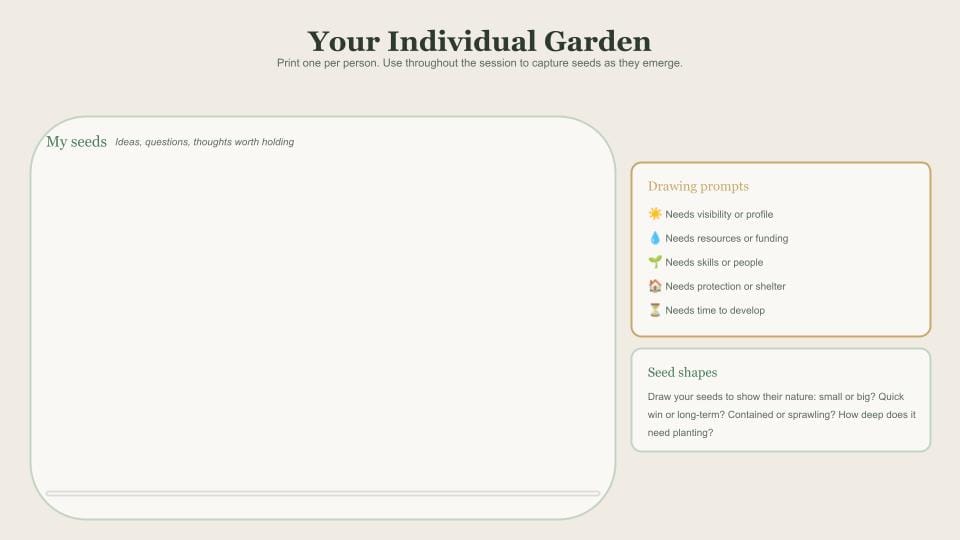
For individuals, it's straightforward: capture your seeds (ideas, tasks, possibilities), then sort them. What are you planting now—actually committing time and energy to this season? What goes in the seed bank for when conditions change? What do you need to compost, finally letting go of things that have been sitting on lists for months?
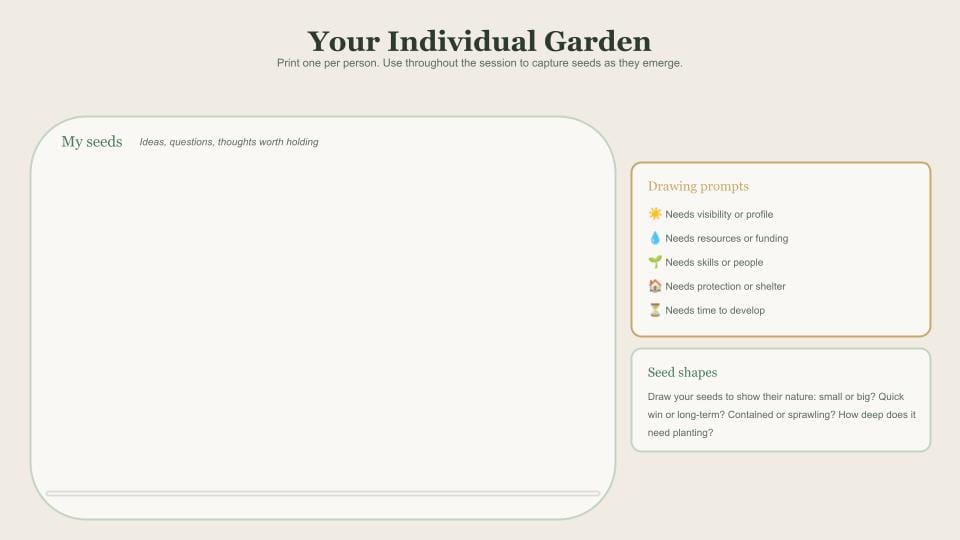
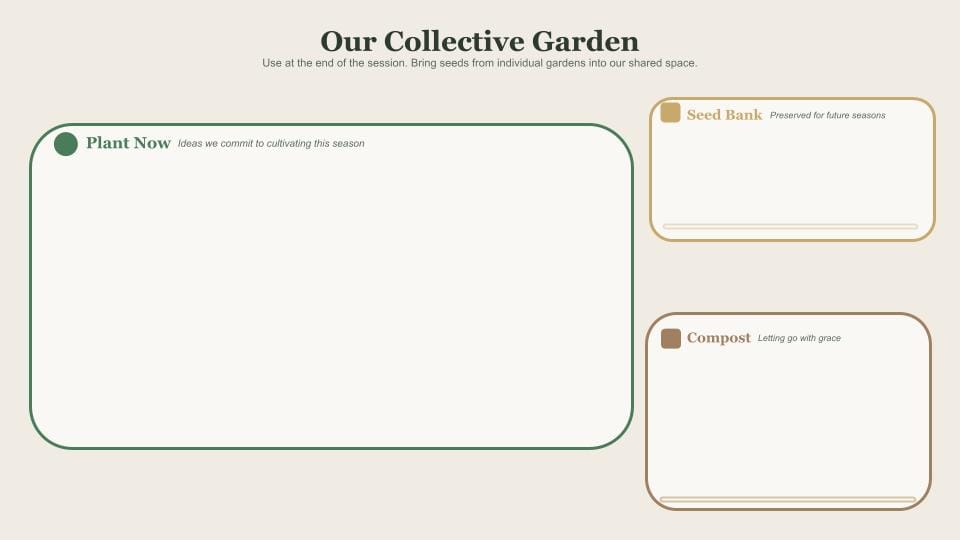
For groups, the framework adds a layer. Each person maintains their own garden throughout a session, capturing seeds as they emerge. A shared seed bank catches ideas that surface when the group can't explore them, and intentionally, you schedule when to return to it. At the close, people bring seeds from individual gardens into a collective space, deciding together what to plant, bank, or compost.
The sorting conversation
This is where the metaphor earns its keep. For each idea, ask:
- Plant now? What does this need to grow? What resources, time, skills, people? Who will tend it?
- Seed bank? When will conditions be right? What needs to change first? When do we revisit?
- Compost? What would this free up if we let it go? What space does it create?
The language gives permission to make real choices. "Composting" doesn't feel like failure, it feels like making space for what can actually flourish. And the seed bank offers a middle path between doing everything now and abandoning ideas entirely.
A word on pruning
Some facilitators struggle with groups who want to plant everything, or individuals who can't let anything go. The garden metaphor helps here too: a garden can only hold so much. Trying to grow everything means nothing gets the attention it needs.
Pruning isn't cruel. It's care (talking to myself while pruning the lavender....)
Using the toolkit
I've put together a simple toolkit with printable worksheets - an individual garden sheet, a seed bank poster, and a collective garden template. It's designed for multi-session facilitation but works just as well for a personal quarterly review or a team planning day.
The toolkit is freely available under Creative Commons (CC BY-NC 4.0). Use it, adapt it, see what grows.
The Garden of Ideas emerged from years of facilitating strategy sessions with organisations, where good ideas often got lost in the shuffle or the HiPPO (Highest Paid Person's Opinion) and from my own struggles/hatred with to-do lists that never seemed to shrink. If you use it, I'd genuinely love to hear what worked and if you adapt it, pay it forward with Open Licensing!