Weeknote 47
Another shorter week, trip to northern ireland, delivering a workshop on question based approaches to data, meeting new people, prepping for TechFreedom first cohort, making Bearing a tool for choosing AI models.

So it's still the Easter holidays up here, so a shorter week, only working 3 days. Feel like I've crammed a lot in, with a quick visit to Northern Ireland at the end of the week which was lovely.
What I did
- Spent time planning out the Collective Resilience sessions as part of the LBF OR programme. We've spent a lot of time on the Organisational Resilience part of this programme and feel it's been both well designed and useful. But we know that no matter what organisations do themselves, some things are systemic, and that there needs to be a focus on Collective Resilience. This is a more difficult design, things are so very different in every place, and taking action is harder, because it's not just you and your organisation. But I'm very conscious that even though it is harder, we don't need to make it complicated. Honestly I think there is too much waffle in systems change stuff, too many consultants talking obscure language and fancy diagrams.
- Delivered a workshop for Sheffield Futures as they embark on a programme of work to improve how they learn, how they think and talk about data. It was with a whole range of people across the organisation, many who had NO interest really in data. And that's precisly why I talk about curiosity and questions. The question based approach was pretty much the foundation of Data For Action, and just because DFA is going away, it doesn't mean the approach is. Kirsty talked about the work better than I ever can
 Kirsty Sandamas
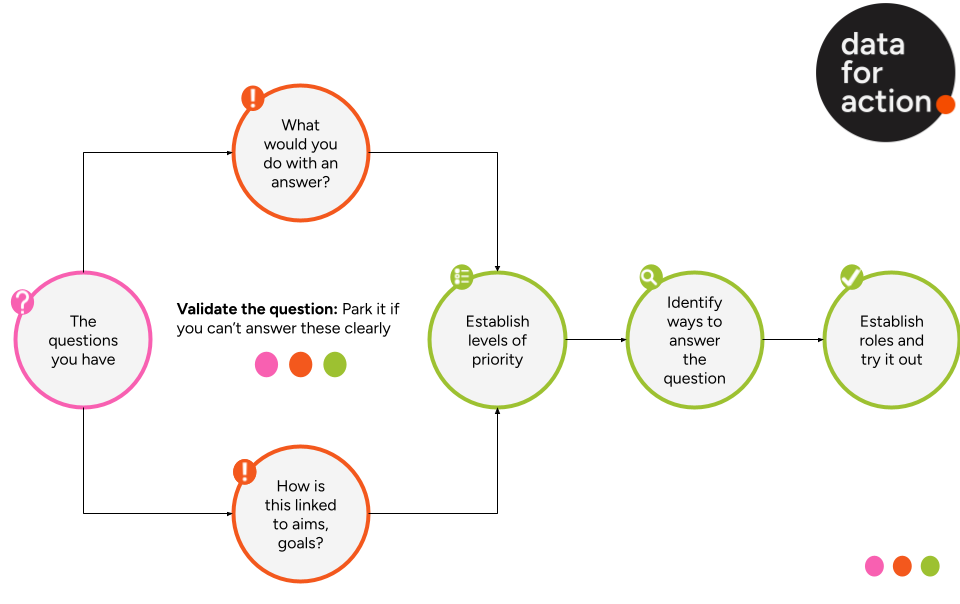
- You can run the above approach with post its, a canvas, a conversation or a free online tool https://www.questionsforaction.com/
- Met Graham from the Movement Research Unit for a great chat about TechFreedom and a range of other things. I love meeting and learning about things I never knew existed (like the MRU) and seeing the really interesting things they do!
- Spent some time finalising session 1 for the TechFreedom cohort. It starts next week and I'm a mix of excited and nervous. I think it will be good, but I'm certain there will be things we will learn from. You can still sign up for the cohort (or the newsletter if you're still on the fence)
- Found out that we'll be running a TechFreedom session at TechNext in June
- Spent a bit of time playing around with the Volunteering Data repo which was put together by ODI and others. I'd read a post about it the week before, so had a poke around, ending up building a working MCP server and then creating a demo dashboard of some of the data via an LLM. It was an interesting experience, seeing what was possible, and where there are gaps both in the data and in the infrastructure.
 dataforaction-tomTom Watson
New tool
Built a new tool called Bearing. Bearing is an AI model recommendation tool which asks you to describe what you want to use AI for, choose what matters most to you (quality, speed, transparency etc), and Bearing will rank the best models for your specific task. I built it to hopefully challenge people to not just default to the most expensive or frontier models when they don't need to, and to perhaps embrace smaller and open source models, which cost less both financially and resource wise. There are hundreds of models out there, but most will only ever encounter one of the big three (claude, chatgpt, gemini). I think tech should be about informed choices, so this is one way I hope to bring a little light to knowledge around AI models.
In my own work, I'm constantly looking at which model is best for which job, often combining models in a tool. Even as someone doing this a lot, it's tricky to always keep up to date, so this was a tool and a thought exercise for me as much as anyone else. I found defining the scoring hard, and it's very much a work in progress.
Part of the other reason for building the tool is to build a bit of an open data set around what people actually want to use AI for. Whenever anyone uses the tool we create a record of the type of thing they want to use AI for, not the actual prompt, but an anonymised categorisation. I think this dataset could be useful, and is live and open on the site.
I've built the tool as transparently as possible, the scoring, the methodology, the code, all open. I hope others will help to improve it. You can see the tool below and read the documentation here and find the repo here.
Has a visit to Northern Island at the back in of the week. Stunning scenery at Giants Causeway and the coast. Visited the Old Bushmills distillery and went extreme and had a 21 yr old bushmills which was incredible. Had at least one customary Guinness






Links This Week
- The AI Memory Problem: How I Built a Second Brain for My Agents | lujo.dev
- Google to tap into gas plant for AI datacenter in sharp turn from climate goals - downgrade for Google sustainability score in Bearing on the back of this obviously
- Civic AI Tools - MCP Demo
- I Built an AI Chief of Staff to Manage My Life Across Five Domains | Ian O'Byrne -
- Who Decides When AI Decides? A Cooperative Response | Platform Cooperativism Consortium
- Shitty Maps are Helpful - I love this, both the swearing and the concept that the process of maps are often the important thing.
- Stop pretending evaluation is neutral
- Proton Meet Isn't What They Told You It Was - TECHFREEDOM is hard!
- Opening your research funding data: a practical guide for funders - OpenAlex blog
- Toolbox — Beautiful Trouble
- Endgame for the Open Web - Anil Dash
- The Firewall.