Weeknote 62
Co-ops are vibe, running a RELAY, meeting new people, doing diagrams, usual waffle.
- The start of the week was fairly busy. Began with a coaching session with Jesse, who probably listened to me unload a little bit of my general frustration with the wider workings of the social purpose sector: a closing down, a lack of collaboration, a lack of imagination, and me generally feeling a little bit grumpy about the whole situation. I did have a moment of serendipitous colour coordination between my hat and my coffee cup, which was good. Jesse helped me with a few things, and it's good to get coaching. I think it's good for you. It's good for me anyway.
- Met with a new client who's grown rapidly over the last 6 months and is really trying to play catch-up with all of their systems.Also caught up on general bits of client work at the start of the week including write up of an Organisational Resilience session I ran last week, and trying to help an organisation make decisions on their systems. Often the decisions are fairly easy for me to help with, but in this case the organisation is a little bit different, so their needs are very nuanced, and there aren’t many tools built for such nuance…
- Also met with Ali on monday, which was lovely. Always sharing useful, sensible things on the internet, so it was great to talk.
Tuesday we ran a FIELD STATION experiment "How might we run AI in a different way?" - you can read what we were doing here.
Did it work? Yes and No. If this was a product test, then absolutely no! The thing that we've built, which kind of splits open-source models across multiple machines through the browser, does work, although it is a bit flaky. We ran into technical problems during the live experiment, meaning some bits worked and some bits didn't. But it wasn't a product test! (here's the tool we made for it if you are interested - use at your own risk)
What we were really looking to do was experiment, so in that sense, yes, it did work. We learned a huge amount! We met some really interesting people who were exploring various angles around this: some people I've known off the internet for a while and some new people. Lots of really rich discussion. The experiment really showed us both the possibility, I think, of something like this and also the challenges that need to be addressed. I've already begun, later in the week, working on some of those challenges and improvements, moving into a new era of the approach. It really reinforced that doing it in the open is brilliant because you get to meet people who are also curious about this and want to do things.
Thursday I was in London for the Co-tec AI and Communities and Cooperatives event, which was very interesting. I'm not part of a co-op, but I've worked with some. Co-ops have such a lovely vibe and I was made to feel very welcome.
I think that the day was really interesting for me to hear from people who were developers who have both been wary of AI and also have used AI, and the tensions.
- Maybe it improves productivity in certain areas, but then, if you're charging a daily rate with some of your clients, what does that mean? What do you do there? You're obviously faster in lots of ways, but does that mean you're cheaper?
- I heard from some people whose productivity had massively increased in some ways: the volume of code and the things that they're able to do increased, but there was massive mental burnout from having to review all of that code and context switch. Just because you can now work on five codebases at one time when previously you couldn't, because you couldn't write that much code. You have to context switch. You have to be aware of the architecture, thinking about the wider: What does all of this mean, and where does it fit? Are we making the right decision? That's an awful lot of mental load that people are dealing with, and you've got all these two pressures kind of converging: you're expecting people to produce more, produce faster, yet actually, the mental load of that means that's harder to do, or at least for a long time, a long term.
In all the discussions around AI I think we miss the wider point around the changing nature of work, no just job losses.I think that burnout risk is real.
There were also discussions around where the gaps in knowledge are going to appear. If you've written code, you can review it, and you can understand the kind of architecture. AI machines, the frontier models now, can probably write better code than you could previously, but how do you consciously make the decisions? Do you have the experience to do that? Will it even matter in a few years?
I think we're in this weird transition between those who have had knowledge of the previous way of doing things, converging with a rapid explosion in capability. I think we're in this middle ground of figuring out: What does that mean? I think people need to become architects of products and code rather than coders, but applying that mental model takes a bit of a shift, and then it applies to business models as well. What does that even mean?
There was a panel discussion with Amanda , Giuseppe, and Mhairi. Lot's of things I could pick out here, but I kept coming back to value. What value and for who? We keep measuring in efficiency and productivity, but if you read the section above then I think we're thinking about value in the wrong way.
I think one of the things that came through from Giuseppe when he was talking was around the idea that it still comes back to use cases and value.
We used to have this thing around user-centred design, or service design, and most of the digital support infrastructure around the social purpose sector have just skipped over that. Again, I think we're at risk of just moving into an era where we just overwhelm people to do things that have no real value. Remember when everyone was telling you that you need to be doing ‘big data’. I bet they are the same ones telling you to ‘do AI’. Ok cool, but why?
Also lots of talk about trust in AI, but not much about being trustworthy
Elsewhere, I started working on something called RELAY, which is the next stage of this distributed shared AI running across multiple machines across networks, sharing and distributing open-source models in a peer-to-peer way. I mentioned that the field station experiment had some challenges. One of those was redundancy. If you've got five people and you all share a model sliced up into layers across the web browser, all very well and good, but what happens when somebody closes that browser, the whole model collapses. How do you build in redundancy?
RELAY is one of the ways that I've begun exploring how to do that. This wouldn't be web-based or require shared browsers, because I think that's a wrong delivery mechanism or interface mechanism for something like this. Basically, what it does is a bit of an orchestration layer, considering who has a GPU, who has storage, and what the latency challenges are. It uses workers to distribute models across them. They're a little bit like the old BitTorrents, trying to think about peer-to-peer distribution of this and creating copies of layers across a network so that you do have a bit of redundancy.
Anyway, really scrappy diagram here
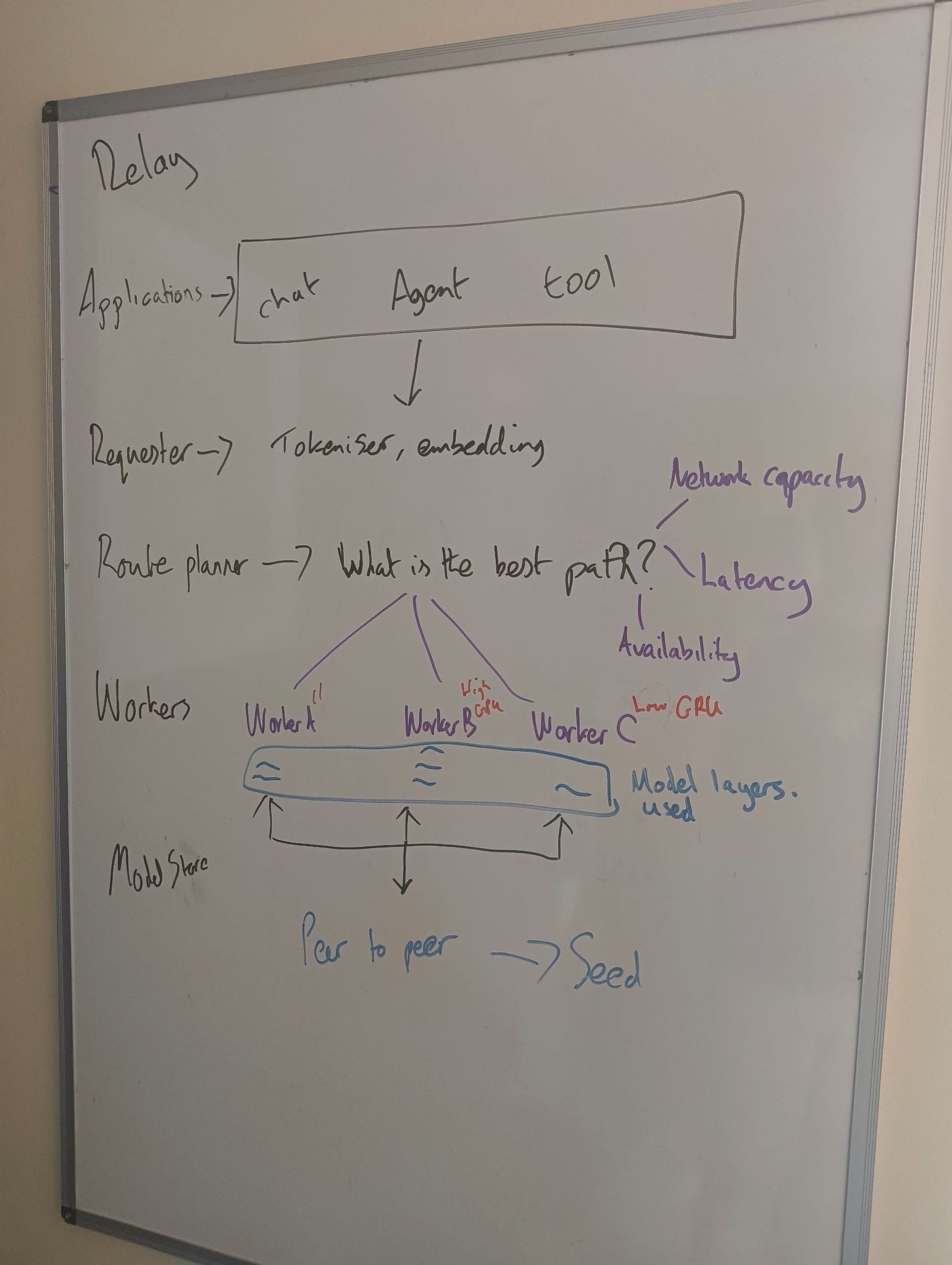
and then a bit of a more well-crafted diagram here.
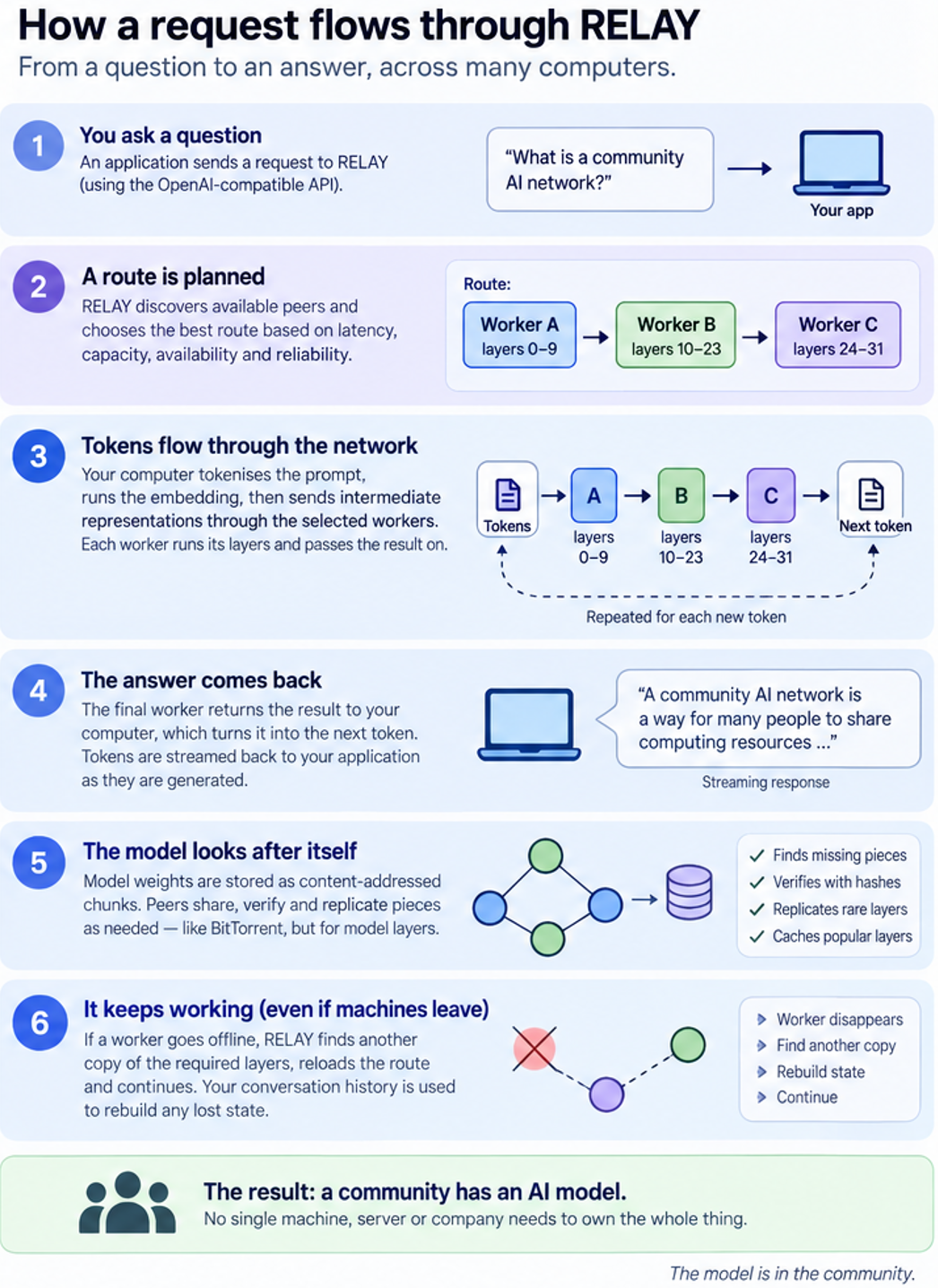
This will probably be the next stage of the FIELD STATION experiment. Watch this space!
Friday, forest Friday, lots of running. Enjoyed that. Played on my guitar again this week. Did some school work.
Interesting things
- Gensyn | Introducing open-1b: the first model you don’t have to trust - Auditable training is the best defense against the future of AI we’re being warned about.
- Governance Analysis #2: How is Digital Sovereignty Measured Beyond Physical Location?
- From crisis to catalyst - Collective visions for civil society and philanthropy in 2026 and beyond
- Product for the People 2026 lightning talk: From A to Z — notes -
- Atlas of Data Center Politics - An interactive research atlas mapping the territorial politics of data centers: facilities, policy, political events, and the actors that connect them.
- Care 2027: A Good Life in Every Neighbourhood - We will publish our proposal for reforming the English care system early in 2027 and we would like your help.
- An E-ink bird frame for Raspberry Pi - real-time bird detection by audio, fully local AI, rendered as real, hand-cut 1800s bird illustrations? Yes please (thanks to Doug for sharing this)