Recap May - July
My somewhat regular round up of all the posts and weeknotes and things I’ve been up to, for those of you who said you might like such a thing. the first TechFreedom cohort finished, The Slow Post happened, the Organisational Resilience programme came to an end, FIELD STATION emerged
Since the last one: the first TechFreedom cohort finished, The Slow Post happened, the Organisational Resilience programme came to an end, FIELD STATION emerged, I did a lot of thinking and building around smaller and more local AI, and I continued to spend an unreasonable amount of time thinking about plywood.
New things
Alongside the writing and the client work, I’ve also released, announced or started testing a number of new things.
Tending
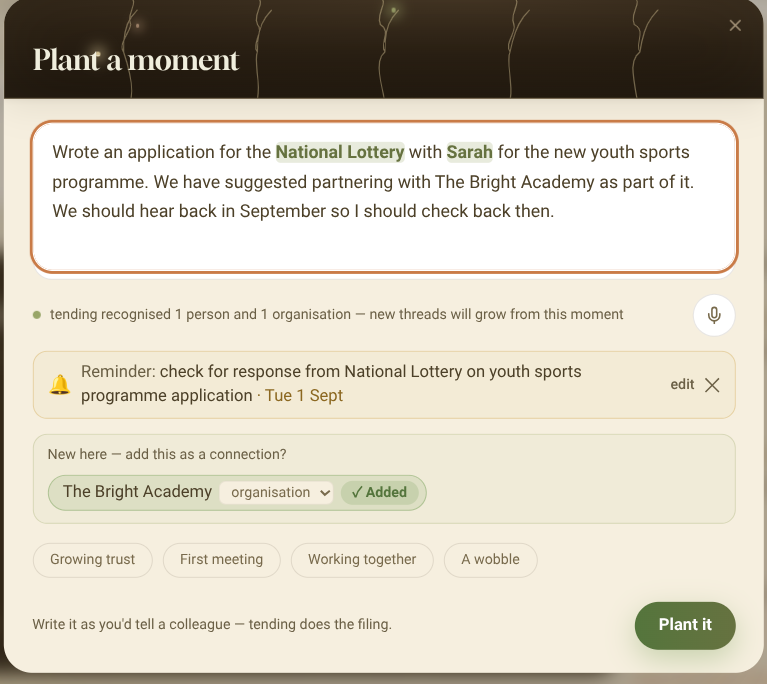
Tending is a tool for seeing and caring for the living network of relationships beneath social-purpose work. Rather than behaving like a conventional CRM, it lets you record moments in ordinary language — written or spoken — and recognises the people, organisations and places involved.
Over time, those moments build a picture of the network: where trust is growing, where connections are strengthening, where a relationship has gone quiet and where too much depends on one person. It is less about managing contacts and more about noticing and tending the relationships through which work actually happens.
FIELD STATION: our first essay and experiment
FIELD STATION is the new action lab Doug Belshaw and I have started to investigate the future of work, technology and society by writing, building and experimenting in public.
Its first essay, The Sovereignty Stack Has No Bottom, argues that technological sovereignty is not something you simply achieve. Every layer of apparent independence rests on another layer of infrastructure, hardware, energy or geopolitics that somebody else controls. Sovereignty is perhaps better understood as a ratio: how much of the stack can you see, influence and choose?
Experiment #001 tests one small alternative in practice. A group of us are using co/core to run AI tasks for one another on computers we own, with each completed job producing a signed public record while the prompts and outputs remain private. It is an experiment in whether AI infrastructure can be organised around reciprocity, transparency and relationships rather than simply rented from a distant platform.
The next TechFreedom cohort
After completing the pilot, Doug and I announced the next TechFreedom cohort, running from 16 September to 14 October. Across three sessions, a small group of social-purpose organisations will map their technology dependencies, assess them through five risk lenses and develop a practical roadmap towards greater technological sovereignty. Join us!
A free TechFreedom taster session
Not quite ready to go all in? We’ve also announced a free online taster on 9 September for people who are curious about TechFreedom but not yet ready to commit to the full programme. This is based on the successful session we ran at TechNExt.
Soundings
Soundings is an open-data tool organised around questions rather than datasets. You can ask a plain-English question about a place in England and receive an answer (charts, maps, insight) grounded in named sources, drawing on 65 indicators across areas including deprivation, health, housing, the economy, infrastructure and civil society.
Swells
Swells is a platform for collecting observations, identifying emerging signals and prompting reflection. People can quickly record something they have noticed through text, photographs or voice; AI then helps surface patterns across those observations that might be difficult for any one person to see. It's also quite pretty.
Glade
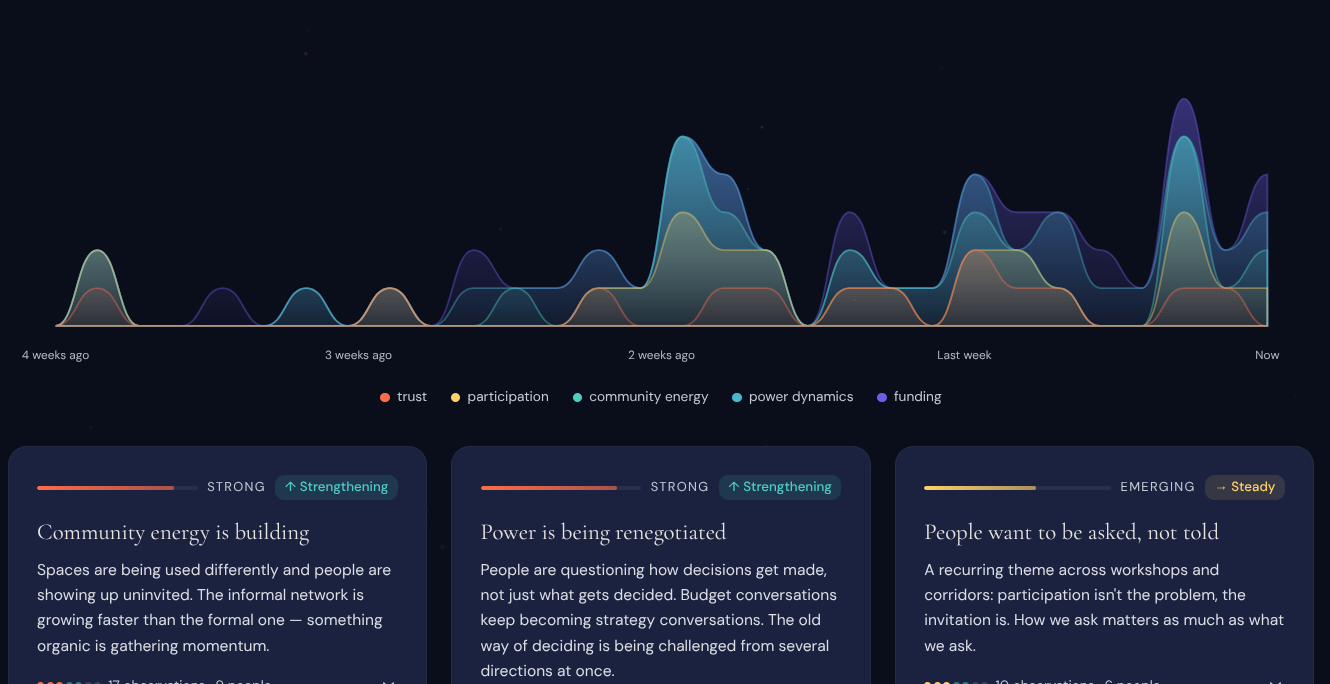
Glade is a decision-centred governance platform for charities, co-operatives, CICs and partnerships. It treats the decision log as the spine of an organisation, connecting decisions to proposals, meetings, actions and living governance documents. The most useful features I think are the 'how do we make decisions' features and the onboarding recap of all our governance. These AI assisted features allow you to actually explore how you make decisions (who, how, and even where you don't) and is especially useful for onboarding new people who can get an overview of the approach without having to read years of meeting notes.
Main posts
Building Soundings: a question-shaped layer over UK open data — 20 July 2026
A look under the bonnet of Soundings, an MCP server that wraps a collection of UK open-data sources in question-shaped tools. It explores questions as infrastructure, the difficult and unglamorous work of joining data together, and using AI for interpretation while keeping the actual numbers firmly in deterministic code.
Put down the firehose — 1 July 2026
Most of the things we use AI for probably don’t require the largest and most expensive models. Working with smaller local models forces greater precision, better processes and more deliberate choices while potentially improving privacy, sustainability and cost without sacrificing much quality. Pick up the water pistol instead.
If everything is a neighbourhood, is anything a neighbourhood? — 12 June 2026
Neighbourhood has become one of those words that everyone uses while meaning completely different things. I explore administrative boundaries, statistical geographies, community identity and why treating neighbourhoods as neat, fixed units risks missing how people actually live and connect.
Responsible AI? — 12 June 2026
A write-up of a provocation I gave to the Food Ethics Council while they developed their AI policy in the open. The food movement already knows plenty about provenance, power, supply chains, honest labelling and the difference between being a consumer and a citizen. Those might be more useful foundations for responsible AI than another list of approved products.
Strap in (and harness up) — 3 June 2026
A ramble through the history of climbing equipment and the current state of AI. Models are improving rapidly, but much of the useful capability sits in the harness around them: tools, instructions, verification, data and workflows. Get the harness right and you can change the model; get it wrong and you’re tying the rope around your waist.
Weeknotes
Weeknote 59 — 18 July 2026
Reflection as an outcome in itself, another successful question-banking session, winding work down for summer, campervan setbacks, and an entirely sensible 1980s arcade game pitting an applicant AI against a funder AI.
Weeknote 58 — 13 July 2026
Catching up with people old and new, thinking about how good work spreads rather than scales, and beginning FIELD STATION’s first essay and experiment. I also shared early versions of Tending and Soundings: one organised around relationships and moments, the other around questions rather than datasets and dashboards.
Weeknote 57 — 6 July 2026
A very busy week of client work, workshops and changing plans in the room. FIELD STATION became a real thing, I wrote about local-first AI, did some decent running, waited in a B&Q car park, insulated the campervan and made some exceptional mushroom and lentil wraps.
Weeknote 56 — 26 June 2026
Lots of running in the Lakes, including rescuing a very thirsty lamb, alongside smaller advisory projects and TechFreedom planning. I also explored the productive constraints of local-first AI, rebuilt the Question Bank and started shaping the rather ambitious thing that became Soundings.
Weeknote 55 — 20 June 2026
The final session of the six-month Organisational Resilience programme and a reminder that reflection, connection and the conditions around learning are not wasted time: they are the work. We also ran a mini TechFreedom session at TechNExt, I improved Glade after releasing it too soon, joined the Ada Lovelace Institute’s Community Forum and found a dinosaur in a cathedral.
Weeknote 54 — 14 June 2026
The Slow Post week. I switched off, went outside, listened to birds, noticed flowers and remembered that I’m usually running, in several senses of the word. There was also work on responsible AI, neighbourhoods, organisational resilience resources and several open tools, but mainly: go slower.
Weeknote 53 — 5 June 2026
Protecting boundaries and returning to Forest Fridays, overwhelmingly positive feedback from both TechFreedom and the Organisational Resilience programme, early planning for FIELD STATION and a climbing-history-meets-AI blog. Plus TechFreedom stickers and an excellent pastel de nata.
Weeknote 52 — 31 May 2026
A double weeknote covering the end of the first TechFreedom cohort, improvements to Bearing, sharing Glade with the world, more local-agent experiments and the beginnings of The Slow Post. Also a trip to Cornwall, lots of sea and coast-path running, some silly cartoons and thoughts about finding more long-term, slower work.
That's it for now. I'll be switching off for summer, so probably less in the way of weeknotes, writing and new things for a while.
Help keep this stuff open
Most of what I write, build and share is open, free to use or deliberately very reasonably priced. That doesn’t mean it costs nothing to make. It means I want useful ideas, tools and infrastructure to remain accessible to smaller organisations and people who might otherwise be priced out.
If any of this has been useful, you can support the work through The Good Ship’s open ledger. You can also subscribe to one of the products, including Tending, Swells or Glade.
Subscriptions help sustain the product you’re using, but they also make it possible to keep more of the surrounding work open: the experiments, frameworks, data, writing and small tools that might never make much commercial sense but still feel worth putting into the world.
They also occasionally fund baked goods for the Pastry Index.